The Ideal Template for Emails
Abstract
A banker reads a cold email on a phone and decides in a few seconds whether to answer. Our default template is built for that reading: one shared detail up front, one line about who you are, and one small ask. A non-target engineering student who was a grade too old to recruit sent it to 71 bankers and 12 wrote back.
The problem
Bankers get a lot of email from students, and most of it reads the same: a paragraph of background and praise for the firm, then a request that is hard to say yes to quickly. Nothing in it gives the banker a reason to answer this one instead of the other 20 cold emails they got that morning.
Replying costs the banker something. They have to work out what you want and then find a slot for it. A good cold email makes each of those steps cheap.
The template
This is the email every Mapped draft starts from.
Subject[connection] Connection | [your.headline] Interested in [banker.group_and_firm]
Hi [banker.first_name],
I hope all is well. My name is [your.name], and I’m [your.introduction].
[ai.connection]
Would you be open to a 25-30-minute call to discuss your experience in [banker.group_and_firm]? I would greatly appreciate your time and any insights you could share.
I’ve attached my resume for reference.
Best,
[your.first_name]
SubjectTeaching Assistant Connection | UIowa Computer Science Student Interested in FSG at Piper Sandler
Hi ,
I hope all is well. My name is , and I’m a junior computer science & engineering student at the University of Iowa interested in investment banking.
I noticed you were a teaching assistant at the University of Iowa and wanted to reach out, as I’m currently a teaching assistant for Digital Design.
Would you be open to a 25-30-minute call to discuss your experience in the Financial Services Group at Piper Sandler? I would greatly appreciate your time and any insights you could share.
I’ve attached my resume for reference.
Best,
Most of it is fixed text. The highlighted words are filled in from your profile and the banker’s. The blue line is the one part written fresh for each banker: Mapped drafts it from the two profiles. The instruction it works from is to tie the student to the banker through one specific detail the two of them share, in a single sentence.
Why each part is there
The connection comes early. In the body it is the first thing after your name. The student also put it at the front of each subject line. Here are four of them:
- Teaching Assistant Connection | UIowa Computer Science Student Interested in FSG at Piper Sandler
- Automation Engineering Connection | UIowa Computer Science Student Interested in Investment Banking at Deutsche Bank
- GreatAmerica Connection | UIowa Computer Science Student Interested in Lincoln International
- Linn-Mar | UIowa Computer Science Student Interested in Industrials at Bank of America
Before the banker learns that this is another student asking for a call, they see their hometown or the job they had in college. The first question in their head becomes “how do they know that?” The detail has to be real and specific to work. “Teaching Assistant Connection” lands because the banker was one. A line about admiring the firm’s culture could go to any firm, so it tells the banker nothing about you.
Who you are takes one line. Your name, year, major and school. The banker needs enough to place you and no more. Your GPA and club roles are in the resume if they want them.
The ask is small and has edges. A 25 to 30 minute call about their experience in their group. Naming the length tells the banker exactly what they are agreeing to. Asking about their own work means they can say yes without preparing anything. The email does not ask for a referral or an interview, which they may not be able to give and which would make yes harder.
The resume gets one sentence. The email says it is attached and stops. It does not summarize the resume. If the banker is curious, they open it, and nothing else in the email depends on whether they do.
Nothing needs decoding. The email is short enough to read in one pass on a phone. There is no story to follow and no request hidden between the lines. Each sentence does one job, and the banker can tell what it is.
What happened
A non-target engineering student who was a grade too old to recruit sent this template to 71 bankers. Of those, 12 replied, roughly one in six.
| Emails sent | 71 |
|---|---|
| Replies | 12 |
| Reply rate | 17% |
The replies came from analysts up through a VP, at firms including Morgan Stanley, BofA, Deutsche Bank, William Blair, Baird, Piper Sandler, CIBC, Lincoln International, BMO, Cantor Fitzgerald, Canaccord Genuity and Harbor View Advisors. Most arrived within a day, and all of them converted to a coffee chat. One opened with “Love the connection haha.”
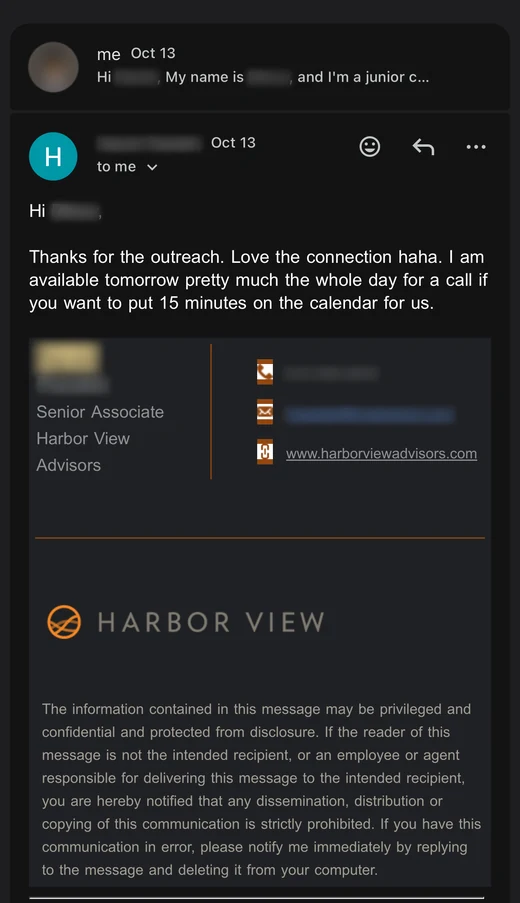
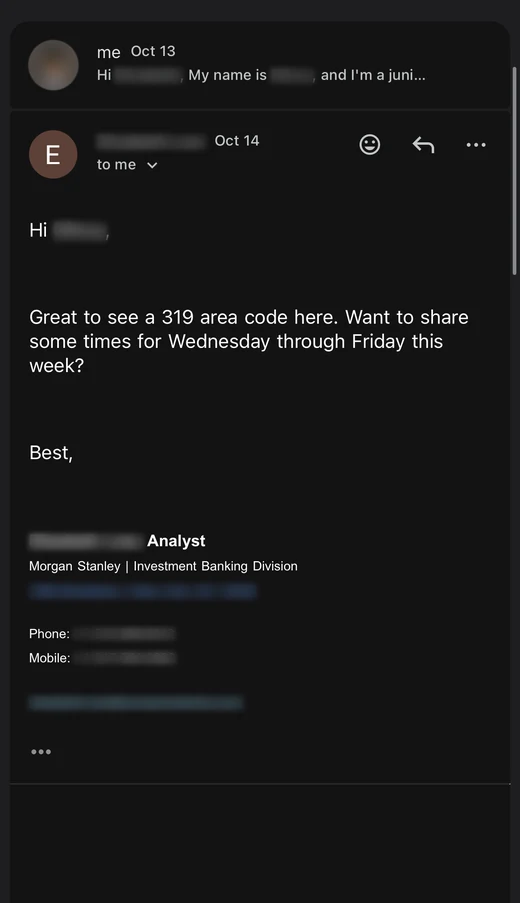
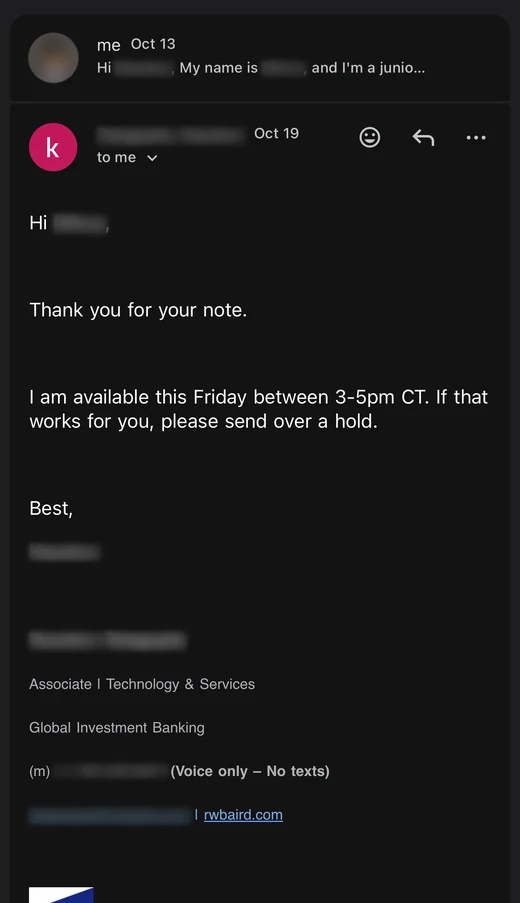
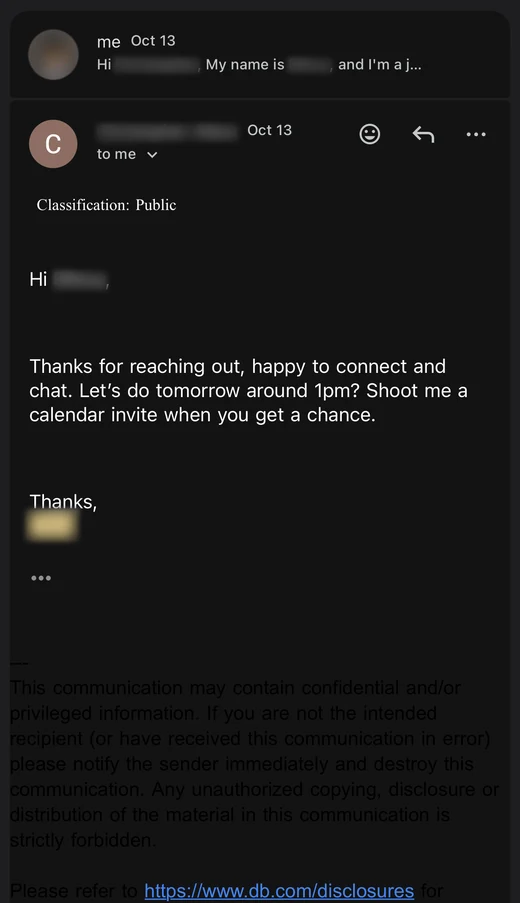
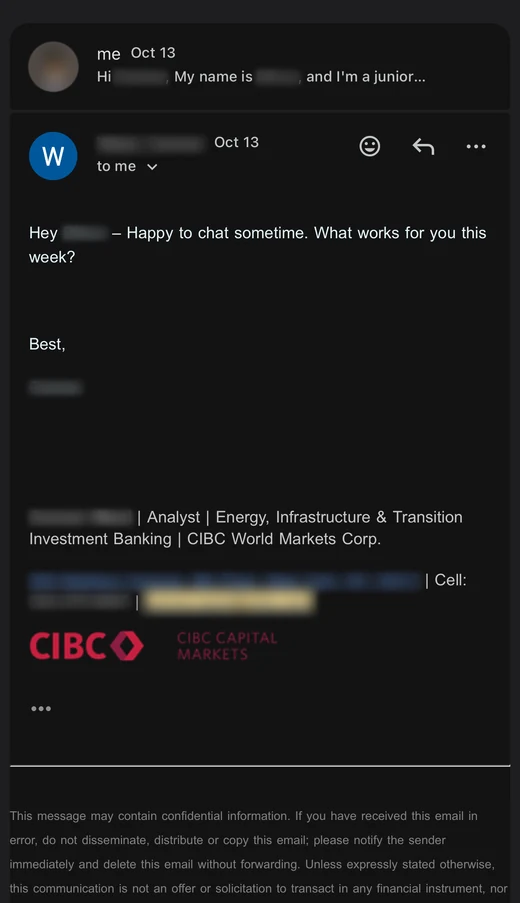
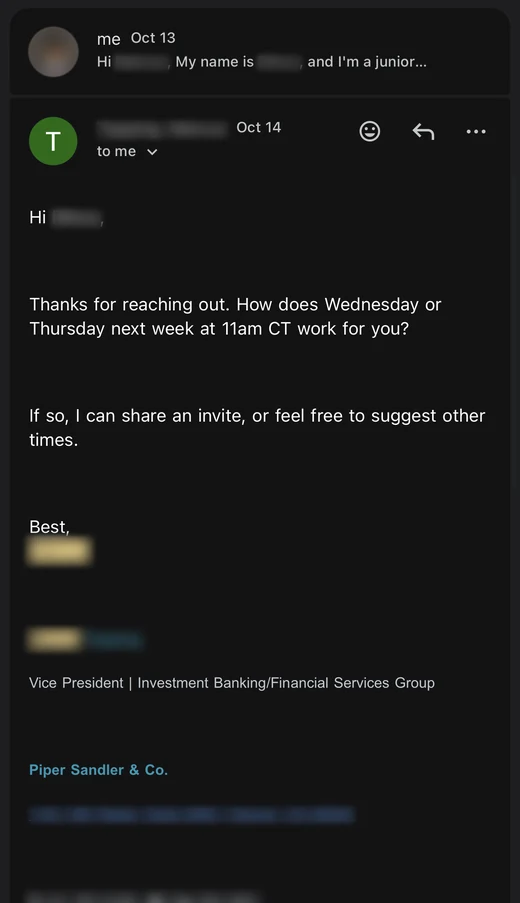
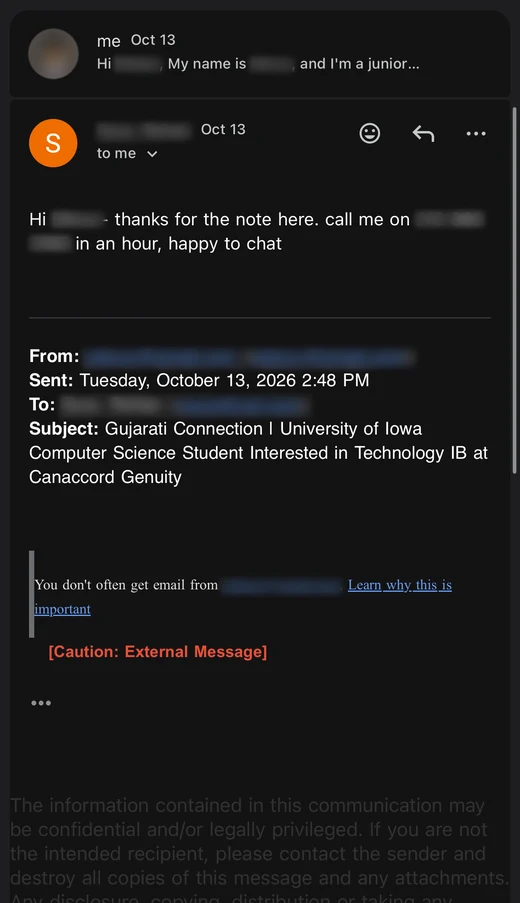
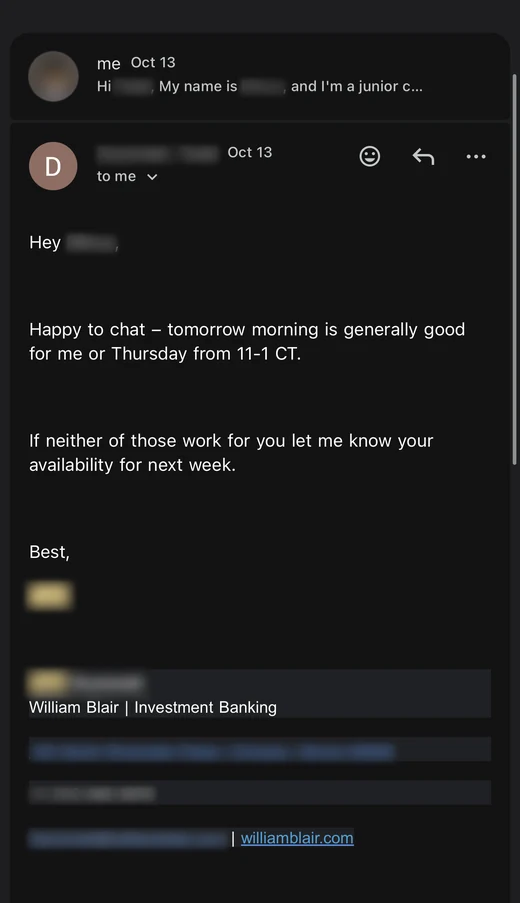
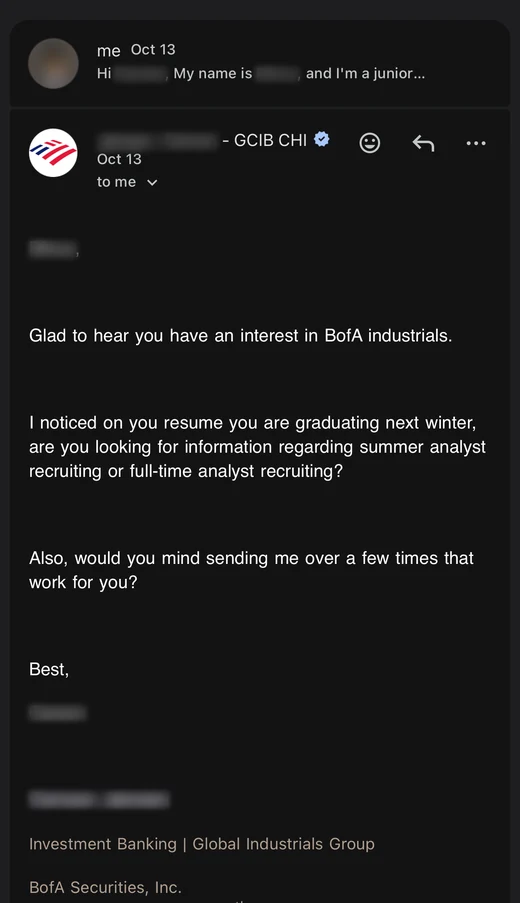
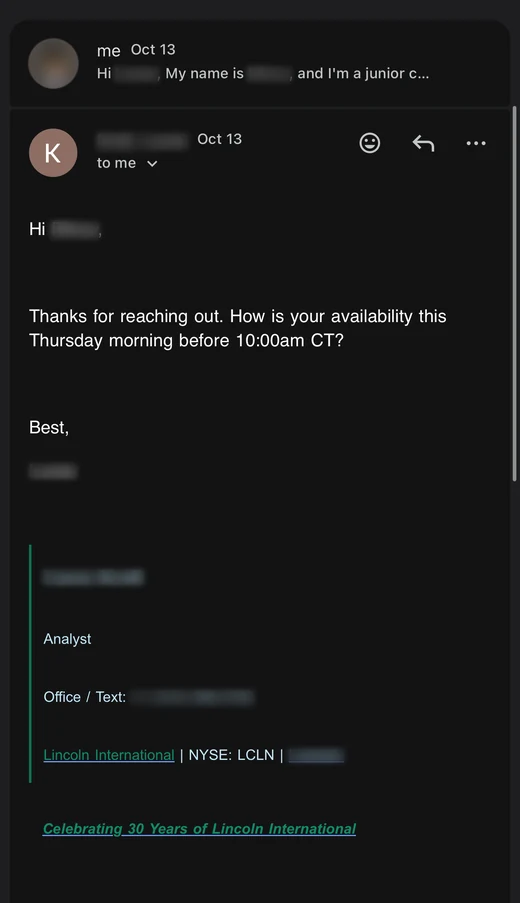
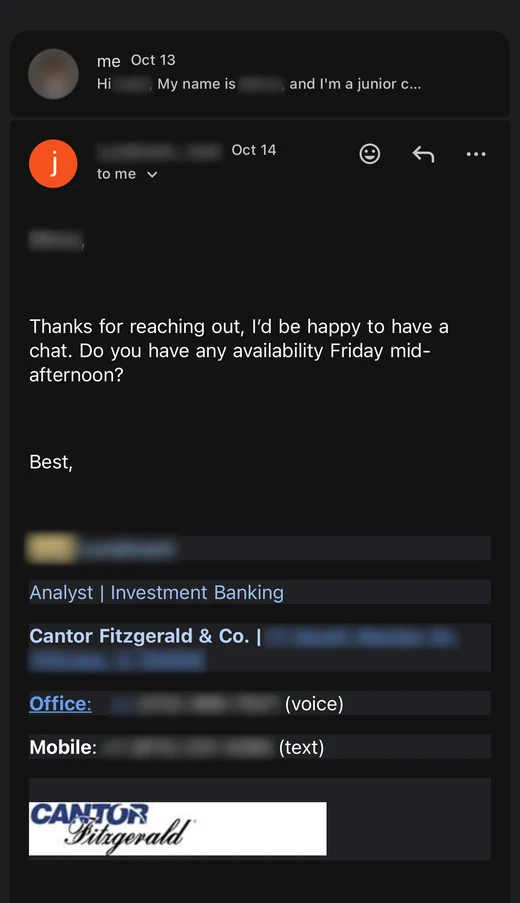
This is one student and one batch of emails, which is too small to promise anyone the same rate. Still, the part a banker chose to comment on was the connection, which is also the part that takes the most work to get right.
The hard part
Nothing about the template is secret. You could copy it tonight. What makes it work is the connection line, and finding a real one means tediously scrolling through the LinkedIn People pages of banks and clicking through bankers’ profiles, searching for a connection to pull. Doing this for 71 people can take precious hours during recruiting.
That is the part we built Mapped to do. It ranks real bankers by how much they share with you, then drafts the connection line from what it found, so the email above arrives already filled in.
If you want to try it on your own list, start here.